

How to Create a Daily Supplement Routine for Athletes
Table of Contents
- Why Athletes Need a Structured Supplement Routine
- What to Check Before You Start: Prerequisites and Safety
- Best Supplements for Athletes: What the Evidence Supports
- Building Your Athlete Supplement Schedule
- Supplement Timing for Athletes: Matching Intake to Training
- Common Mistakes to Avoid in Your Supplement Routine
- Supplement Safety for Athletes: Quality, Testing, and Red Flags
- Conclusion: Putting Your Routine Together
- Frequently Asked Questions
Last Updated: 7 October 2026
Why Athletes Need a Structured Supplement Routine
A daily supplement routine is a planned schedule for taking specific supplements at set times, matched to your training and recovery needs. For athletes, that structure matters more than the products themselves. Random scooping and skipped days waste money and blur your results. Consistency transforms these individual components into a cohesive strategy for holistic athlete recovery, ensuring that every nutrient serves a specific purpose in your long-term physiological adaptation.
At Supplements Sanctuary, we have spent over a decade manufacturing food supplements in the UK. Athletes who plan their intake often report better results.
Below, we will show you exactly how to build a routine you can actually stick to. But first, here is what most guides get wrong: they hand you a list of pills and ignore timing, safety and quality. Those three things decide whether a routine works.
What to Check Before You Start: Prerequisites and Safety
Before you buy anything, sort out three things: your diet, your health status and your medication list. Supplements top up a good diet. They do not replace one.
Start here:
- Check with your GP if you take prescription medicine or have a health condition.
- Read the label for dosage, allergens and age limits.
- Rule out banned substances if you compete under anti-doping rules.
- Set a budget and a realistic number of products, usually three to five.
The UK Food Standards Agency guidance on food supplements is a sensible starting point for what is and is not allowed on the UK market.
Best Supplements for Athletes: What the Evidence Supports
The best supplements for athletes are the ones with a clear role and a dose you can actually verify. Most sports nutrition needs come down to a short list, not a shelf full of tubs.
A common approach is to cover the basics first:
- Vitamin D for bone health and normal muscle function
- Omega-3 fatty acids for general heart and joint support
- Magnesium for normal muscle function and reduced tiredness
- Protein powder to help hit daily protein targets
- Creatine for repeated bursts of short, high-intensity effort
What most guides miss is that food first is still the rule. Supplements fill gaps. They do not patch a poor diet, and they will not out-train a lack of sleep.
Building Your Athlete Supplement Schedule
An athlete supplement schedule works best when you tie each product to a moment you already repeat every day. Meals, training sessions and bedtime become your anchors. The routine runs itself.
Here is a simple weekly setup many athletes use:
| Time of Day | What to Take | Why It Fits |
|---|---|---|
| Morning, with breakfast | Vitamin D, omega-3 | Fat-soluble, needs food |
| Pre-training, 60-90 min before | Performance support, creatine | Fuels the session |
| Post-training, within an hour | Protein, magnesium | Recovery and repair |
| Evening, before bed | Magnesium, omega-3 | Supports rest |
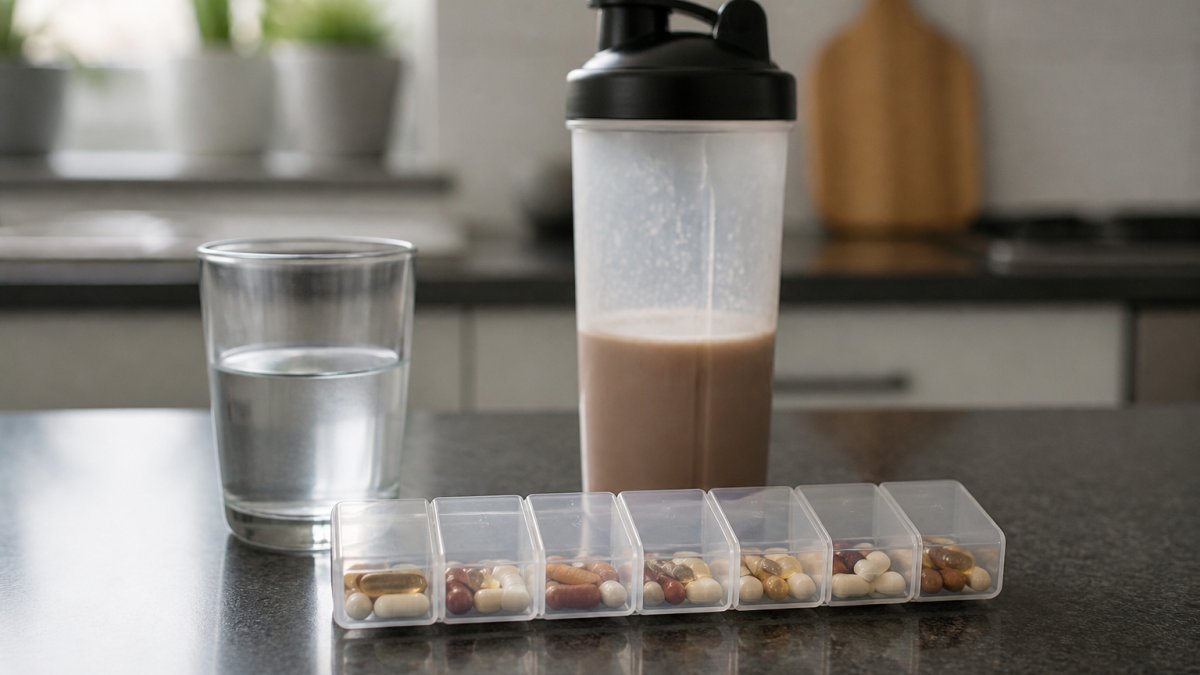
Morning: Foundations for the Day Ahead
Take fat-soluble supplements with breakfast. Vitamin D and omega-3 both absorb better with food. Pair them with your morning meal and you will not forget them.
Keep this block simple. Two or three products, taken with the same breakfast, every day.
Pre-Training: Fuelling Performance
Time your pre-training intake 60 to 90 minutes before you start. This gives the body time to absorb what you have taken.
Our Keskara Performance Support capsules fit here. They combine amino acids and botanicals for adults with active lifestyles, and the suggested use is one to two capsules daily with food. It is vegan-friendly and made to slot into a daily plan, not to replace one.

Post-Training and Evening: Recovery and Repair
Recovery is where most routines fall apart. Post-training, take protein and magnesium. In the evening, keep it light and consistent.
Our Alpha Drive capsules suit this slot for some athletes. Each capsule blends botanical extracts and amino acids, including L-Arginine HCL and Rhodiola Rosea, and is manufactured in the UK. Take one capsule daily, with a second if required.
Keskara Performance Support – Strength & Endurance Booster – Natural Formula →
Supplement Timing for Athletes: Matching Intake to Training
Supplement timing for athletes is about matching intake to the body's needs across the day, not chasing a perfect minute. Consistency beats precision.
Three rules cover most cases:
- Fat-soluble products go with food. Vitamin D and omega-3 need it.
- Performance products go before training. Give them 60 to 90 minutes.
- Recovery products go after. Protein and magnesium within the hour.
If you train twice a day, split your intake around both sessions. Do not double the dose to compensate.
Common Mistakes to Avoid in Your Supplement Routine
The biggest mistake is buying before you plan. A close second is taking everything at once and hoping for the best.
Watch for these:
- Skipping days, which makes results impossible to judge
- Taking products at random times, which hurts absorption
- Ignoring the label, especially dosage and allergen warnings
- Stacking overlaps, which risks exceeding safe levels
- Expecting overnight change, when most support builds over weeks
Supplement Safety for Athletes: Quality, Testing, and Red Flags
Supplement safety for athletes starts with the manufacturer, not the marketing. A product is only as good as the facility that made it and the records behind it.
Look for these signals:
- Batch traceability for raw materials
- Compliance with UK and EU food supplement rules
- Clear labelling with amounts per serving
- A named responsible food business operator
Red flags include vague ingredient lists, no contact details, and claims that sound like cures. The MHRA guidance on medicines and healthcare products explains why products making medical claims cross a legal line.
This is where we draw a hard line at Supplements Sanctuary. Every product carries batch traceability for raw materials, and we manufacture in the UK under strict quality control. We are a Responsible Food Business Operator, and our customers rate us 4.75 out of 5 on average.
Conclusion: Putting Your Routine Together
Building a routine that lasts is the hard part, not buying the products. Start with the basics, anchor each one to a daily habit, and review it every few months.
If you want supplements made to a standard you can check, we can help. Our range is manufactured in the UK, batch traceable, and compliant with UK and EU rules. Browse the range and build your routine with confidence.
Frequently Asked Questions
How do athletes create a daily supplement routine?
Start by identifying your training goals and any dietary gaps, then choose a small number of evidence-backed supplements. Build a supplement routine around your training schedule: morning for daily basics like vitamin D, pre-training for performance support, and post-training for recovery. Keep a written plan, take products with food where directed, and review after eight to twelve weeks before adding anything new.
Should athletes take supplements before or after training?
It depends on the supplement. Performance-focused products are usually taken 30 to 60 minutes before training, while recovery-oriented products are best taken within an hour after exercise. Daily basics such as vitamin D can be taken at any consistent time, ideally with a meal. Always follow the label directions for supplement timing, and do not exceed the stated daily dose.
How can athletes check whether a supplement is safe?
Look for clear labelling, a named UK manufacturer, and batch traceability so you can verify where ingredients came from. Check that the product complies with UK and EU food supplement regulations, and avoid anything making drug-like claims. If you compete under anti-doping rules, check every ingredient against your governing body's prohibited list before you buy. When in doubt, ask the manufacturer for documentation.
Do athletes need supplements if they eat a balanced diet?
Not always, but a balanced diet can still leave gaps. Vitamin D is a common shortfall in the UK, particularly in winter, and athletes in heavy training may struggle to meet increased demands through food alone. A targeted supplement routine can fill those gaps, but it complements a varied diet rather than replacing it. Speak to a doctor or dietitian if you are unsure what you actually need.
The challenge with any supplement routine is trusting what is inside the capsule. Supplements Sanctuary meets that head-on with UK manufacturing, batch traceability for every raw material, and full compliance with UK and EU food supplement regulations. Our customers rate us 4.75 out of 5, and we have been a Responsible Food Business Operator since 2014. Get started with Supplements Sanctuary and build a routine you can actually trust.