

How to Verify Supplement Batch Traceability
Table of Contents
- What Batch Traceability Actually Means on a Supplement Label
- Step 1: Check the Batch Code Before You Buy Anything Else
- Step 2: Request the Supplement Certificate of Analysis (COA)
- Step 3: Confirm the Manufacturer Is Among GMP Certified Supplement Brands UK
- Step 4: Identifying Counterfeit Health Supplements Before They Reach You
- Step 5: Test the Traceability Claim With One Email
- Common Mistakes When Checking Batch Traceability
- Conclusion
- Frequently Asked Questions
Last Updated: 10 September 2026
What Batch Traceability Actually Means on a Supplement Label
Batch traceability is the documented ability to follow a supplement from its raw ingredients through manufacturing, testing and packing to the specific bottle in your hand. For anyone who has ever wondered how to verify supplement batch traceability, the label is where that paper trail begins.
Every legitimate batch carries an internal record: which supplier delivered the raw material, when it was blended, what tests were run, and who signed it off. At Supplements Sanctuary, we hold batch records for all raw materials.
The label itself gives you three anchor points: a batch or lot code, a best-before date, and the name of the food business operator responsible for the product. Those three details are what every later step in this guide hangs on.
Where to Find the Batch Number and Best-Before Date
The batch code is usually printed, stamped or ink-jetted on the base, side or crimp of the bottle, not on the front label artwork. It is often a short alphanumeric string such as L24A118 or B2603.
The best-before date sits beside it. Look for a "BBE", "Best Before End" or "EXP" prefix followed by a month and year. If either marking is missing, smudged beyond reading, or stuck on as a separate peel-off sticker, treat that as a red flag rather than a minor printing quirk.
Step 1: Check the Batch Code Before You Buy Anything Else
A batch code is the single most useful piece of information on the pack, and it takes ten seconds to check. Pick up the bottle, turn it over, and confirm the code and best-before date are printed directly onto the container.
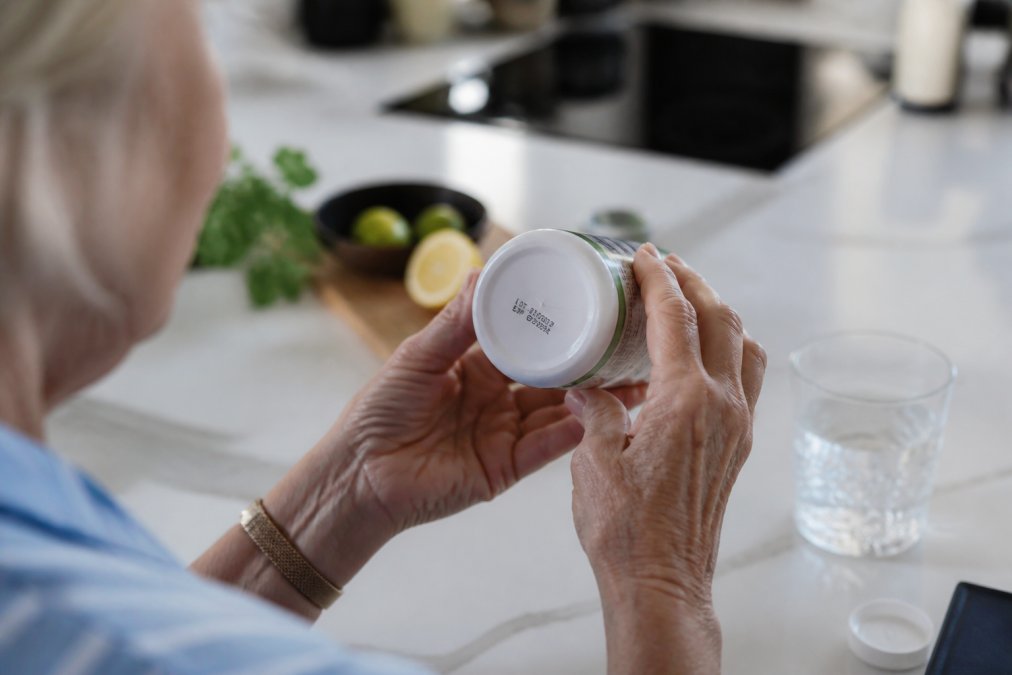
Here is what to look for:
- A code printed directly on the bottle, not on a sticker that could be moved between packs
- A readable best-before date in month/year format
- Matching codes on the outer carton and the inner bottle
- No signs of overprinting, scratching or chemical removal
If you are buying online, ask for a photograph of the base of the actual bottle before you order. A seller who cannot or will not supply one is telling you something.
Step 2: Request the Supplement Certificate of Analysis (COA)
A supplement certificate of analysis (COA) is the laboratory document that reports what was actually tested in a given batch and what the results were. It is the closest thing the industry has to a receipt for quality.
Ask the brand or retailer for the COA that matches your batch code specifically, not a generic sample document. A genuine COA will name the batch, the test date, the laboratory, and the results for each parameter tested.
What a Genuine COA Should Show
Check that the document includes the batch number you hold, the date of testing, the name and location of the laboratory, and results with units and pass/fail limits. It should also identify the product and the specification it was tested against.
Two things most buyers miss. First, a COA covers one batch only, so a document dated two years ago tells you nothing about the bottle in your hand. Second, a COA is not the same as a certificate of compliance. The first reports test results; the second simply states that a specification was met.
Step 3: Confirm the Manufacturer Is Among GMP Certified Supplement Brands UK
Good manufacturing practice, usually shortened to GMP, is the set of production and hygiene controls a supplement manufacturer is expected to follow (the WHO). In the UK, supplement manufacture sits under food law, and the Food Standards Agency guidance on food supplements sets out the labelling and safety framework businesses must meet.
GMP certified supplement brands UK buyers can check are those able to name their manufacturing site and describe the standards it works to. Ask directly: where is the product made, and what quality system governs that site? A brand that answers vaguely, or that cannot name a site at all, has not demonstrated anything.
Supplements Sanctuary manufactures in the United Kingdom and operates as a Responsible Food Business Operator, which means the business is named on the record and accountable for what it sells.
Step 4: Identifying Counterfeit Health Supplements Before They Reach You
Identifying counterfeit health supplements comes down to spotting inconsistencies between what is advertised and what arrives. Counterfeits tend to fail on the small details because copying a label is easy while copying a supply chain is not.
Watch for these signals:
- A batch code format that does not match other bottles from the same brand
- Spelling or spacing errors in the label text
- A best-before date that is implausible for the product type
- Packaging that feels lighter or flimsier than expected
- A seller who cannot supply a COA for the batch you received
The MHRA guidance on falsified medical products explains how falsified products are identified and reported, and it is worth reading if you suspect you have received one. Report suspected falsified supplements rather than simply returning them, because the report is what triggers an investigation.
Step 5: Test the Traceability Claim With One Email
One email settles the question. Send the brand your batch code and ask three things: the COA for that batch, the name and location of the manufacturing site, and the name of the food business operator responsible for the product.
A brand with real traceability answers all three points. A brand without it replies with a general statement about quality commitments and never quite reaches the batch code.
Keep the reply. If a problem emerges later, that email is your record of what the brand told you about the specific batch you bought.
Common Mistakes When Checking Batch Traceability
| Mistake | Why it causes problems | What to do instead |
|---|---|---|
| Accepting a COA for a different batch | Tells you nothing about your bottle | Match the batch code exactly |
| Trusting a "GMP" logo with no site named | Cannot be verified | Ask for the manufacturing site |
| Buying from a listing with stock photos | Batch may not match what arrives | Request a photo of the actual base |
| Throwing away the packaging | Removes your batch code | Keep the label until the pack is finished |
| Assuming a best-before date proves testing | Dates are printed, not tested | Ask for the COA |
The pattern behind all five is the same: accepting a claim at face value instead of asking for the document behind it.
Conclusion
Verifying batch traceability takes about fifteen minutes and one email, and it is the difference between trusting a label and being able to check it. The barrier is rarely the brand's willingness to answer. It is that most buyers never ask.
Supplements Sanctuary manufactures in the United Kingdom, holds batch traceability records for all raw materials, and operates within UK and EU food supplement regulations with clear, accurate labelling on every pack.
Continue shopping
Frequently Asked Questions
What is a supplement batch number and where do I find it?
A batch number is the code that identifies the exact production run your capsules came from. It is usually stamped or printed on the base or side of the bottle, next to the best-before date, and sometimes on the outer carton only. Write it down before you recycle the packaging. With that code, a manufacturer should be able to tell you the date of manufacture, the raw material lots used and the test results for that specific run, which is the basis of any real batch traceability claim.
Can I check supplement authenticity online using a batch number?
Some UK manufacturers let you enter the batch code on their website and see a summary of test results or a downloadable certificate of analysis. If there is no online checker, email the batch number to the company and ask for the corresponding COA. A brand that manufactures its own capsules will answer. One that only resells imported stock often cannot, and that silence tells you as much as the document would.
How do I spot counterfeit health supplements before I buy?
Check the label closely: misspellings, blurry print, missing batch number, missing UK address for the food business operator, or a best-before date that has been over-stickered are all warning signs. Genuine UK-compliant packaging names a responsible food business operator and carries a UK address. Be cautious of heavily discounted stock on marketplace listings, and buy from the brand's own site or a registered pharmacy where the supply chain is documented.
Why does GMP certification matter when I am verifying a batch?
Good Manufacturing Practice certification means the facility follows documented procedures for hygiene, equipment, staff training and record-keeping, and is audited against them. That record-keeping is what makes traceability possible: without it, nobody can link a finished capsule back to a raw material lot. When you look at GMP certified supplement brands UK, ask which body carried out the audit and whether the certificate covers the site that actually made your product.