

How to Read Supplement Ingredient Labels: UK Guide 2026
Table of Contents
- Why Supplement Ingredient Labels Matter More Than You Think
- The Two-Part Label: Active Ingredients vs Other Ingredients
- Common Supplement Fillers to Avoid
- Decoding Units: What mg, mcg, and IU Actually Mean
- How UK Food Supplement Regulations Shape What You See on Labels
- What Is Third-Party Supplement Testing and Why It Matters
- Your Checklist for Reading Any Supplement Label
- Conclusion
- Frequently Asked Questions
Last Updated: 14 September 2026
Why Supplement Ingredient Labels Matter More Than You Think
Learning how to read supplement ingredient labels is one of the most practical skills you can develop for your health. At Supplements Sanctuary, we've spent over a decade manufacturing food supplements in the UK, and we understand how confusing labels can be. The label is your only real window into what you're swallowing every day.
Most people scan the front of a bottle, see "Vitamin D" or "Metabolism Support," and assume the rest is fine print. That assumption costs them. It means paying for fillers, guessing at doses, and occasionally taking something that doesn't match the marketing claim at all.
Below, we'll walk through exactly how to decode every section of a supplement label, from active ingredients to the units of measurement that trip most people up.
The Two-Part Label: Active Ingredients vs Other Ingredients
Every UK supplement label splits its contents into two distinct lists, and understanding the difference is where real label literacy begins. The active ingredients are what actually do the work. The "other ingredients" list covers everything else in the capsule, and it's where manufacturers have the most room to cut corners.
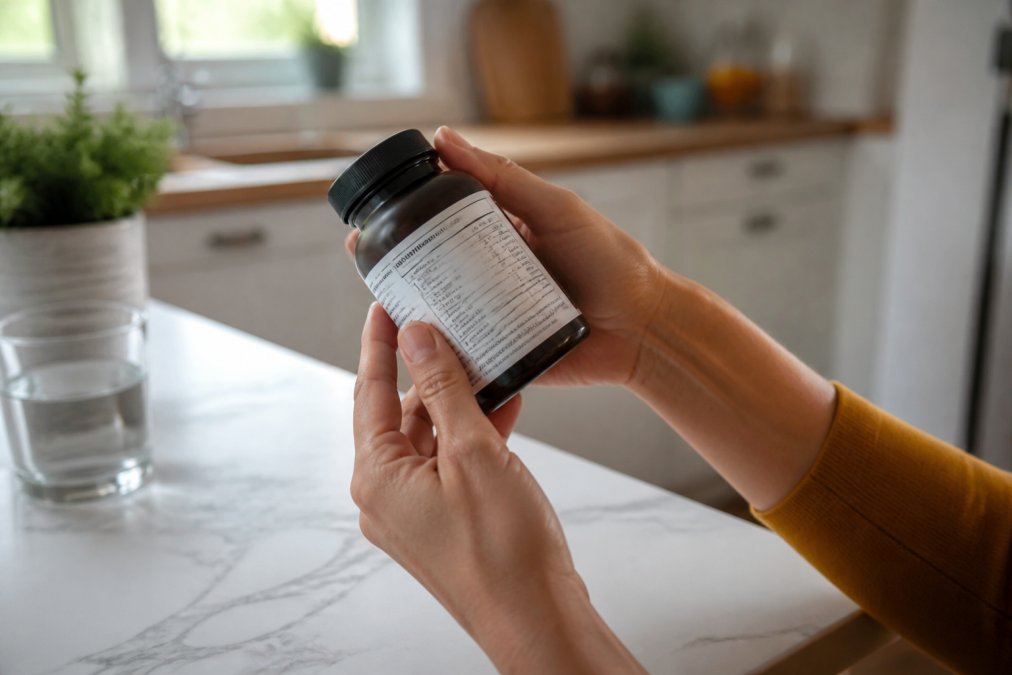
How to Identify Active Ingredients
Active ingredients appear first, usually in a table with amounts per capsule or per daily serving. Each entry names the nutrient or botanical and gives its quantity. Look for the form too: "magnesium citrate" tells you far more than "magnesium" alone, because different forms absorb at different rates.
What Falls Under 'Other Ingredients'
Everything that isn't the active nutrient lands here: binders, fillers, anti-caking agents, capsule material, and flavourings. These aren't automatically bad, but they tell you how the product was built. A short, recognisable list is generally a good sign.
Common Supplement Fillers to Avoid
The most common supplement fillers to avoid include magnesium stearate, titanium dioxide, and artificial colours. None of these belong in a product you take daily if a cleaner alternative exists at a similar price.
Here's what to watch for and why it matters:
| Filler | Common Purpose | Why to Avoid It |
|---|---|---|
| Magnesium stearate | Anti-caking agent | |
| Titanium dioxide | Whitening agent | |
| Silicon dioxide | Anti-caking agent | |
| Artificial colours | Appearance | |
| Hydrogenated oils | Filler |
A common mistake is assuming "natural" on the front label means the filler list is clean. It doesn't. Check the back every time.
Decoding Units: What mg, mcg, and IU Actually Mean
Understanding units prevents the single biggest label misreading: confusing milligrams with micrograms. The difference is a factor of 1,000, and getting it wrong can mean taking far too little or far too much of a nutrient.
- mg (milligram): one thousandth of a gram. Used for minerals like magnesium and calcium.
- mcg (microgram): one thousandth of a milligram. Used for potent nutrients like vitamin B12 and folate.
- IU (International Unit): a measure of biological activity, not weight. Still used for vitamins A, D, and E.
A label reading "Vitamin D 25 mcg" delivers the same as "Vitamin D 1,000 IU (ods.od.nih.gov)." If you're comparing two bottles and one uses mcg while the other uses IU, convert before you judge which is stronger.
How UK Food Supplement Regulations Shape What You See on Labels
UK food supplement regulations require every label to state the category name ("food supplement"), the recommended daily portion, a warning not to exceed it, and a statement that supplements should not replace a balanced diet (Food supplements). These rules exist to protect you, and a compliant label is the first sign of a serious manufacturer.
The Food Standards Agency guidance on food supplements sets out exactly what must appear on a UK label. If a product is missing the recommended daily portion or the "do not exceed" warning, treat that as a red flag regardless of how premium the packaging looks.
What most guides miss is that compliance is a floor, not a ceiling. A label can meet every legal requirement and still hide poor sourcing behind vague ingredient names.
What Is Third-Party Supplement Testing and Why It Matters
Third-party supplement testing is an independent verification process where a laboratory unaffiliated with the manufacturer checks a product for purity, potency, and contaminants. It's the difference between a brand's own claim and an outside party confirming it.
Batch testing matters because contamination risks are real. Independent testing can help identify potential issues before they reach you.
Supplements Sanctuary manufactures in the UK and maintains batch traceability for all raw materials, which means every capsule can be traced back through the supply chain.
Your Checklist for Reading Any Supplement Label
Use this checklist every time you pick up a new bottle. It takes about two minutes and will save you from most of the mistakes people make.
- Active ingredients listed with amounts per serving
- Nutrient forms specified (e.g. chromium picolinate, not just "chromium")
- "Other ingredients" list is short and recognisable
- No titanium dioxide or artificial colours
- Units are clear (mg, mcg, or IU) and consistent
- Recommended daily portion stated
- "Do not exceed" warning present
- Batch number printed on the bottle
- Manufacturer name and UK address shown
- Third-party testing or batch traceability claimed
Conclusion
Reading supplement labels properly takes practice, but the payoff is confidence in what you're actually taking. Supplements Sanctuary was built for exactly this: UK-manufactured capsules with clear labelling, batch traceability for every raw material, and full compliance with UK and EU food supplement regulations. Our range, from GLUCAVIT Metabolic Balance Support to Leaniq Metabolic Support, is made to standards you can verify rather than trust. Continue shopping with Supplements Sanctuary and take the guesswork out of your daily routine.


Frequently Asked Questions
What should I look for on a supplement ingredient label?
Start with the active ingredients section to confirm the nutrients and their amounts per serving. Check the other ingredients list for fillers, binders, and anti-caking agents. Look for allergen information and any third-party testing claims. A clear label will state the form of each nutrient, such as chromium picolinate rather than just 'chromium'.
What are the common hidden fillers in UK supplements?
Common supplement fillers to avoid include magnesium stearate, titanium dioxide, silicon dioxide, and hydrogenated vegetable oils. Reading the 'other ingredients' section carefully helps you identify what is actually in the capsule beyond the active nutrients. Choosing products with shorter ingredient lists often means fewer unnecessary additives.
Are supplement labels regulated in the UK?
Yes. UK food supplement regulations require labels to follow strict rules set by the Food Standards Agency and retained EU law. Labels must list ingredients in descending order by weight and avoid making medicinal claims unless authorised. The 'Responsible Food Business Operator' must be named on the pack. These rules exist so you can compare products and make informed choices.
How do I know if a supplement has been third-party tested?
Look for a certification logo or batch number on the label. Third-party testing means an independent lab has verified the product's contents, purity, and absence of contaminants. Some brands publish certificates of analysis on their website. If a company claims batch traceability, ask to see documentation linking your specific batch to test results.