

Clear & Accurate Product Labelling for Manufacturing Standards
Table of Contents
- Why Accurate Product Labelling Validates Manufacturing Standards
- UK Food Supplement Labelling Regulations: What the Law Requires
- GMP Certified Supplement Manufacturing: What Certification Actually Proves
- Traceability in Supplement Production: Following a Batch from Supplier to Capsule
- How to Check Supplement Quality Assurance Before You Buy
- Common Labelling Mistakes That Weaken Manufacturing Validation
- Frequently Asked Questions
Last Updated: September 17, 2026
Why Accurate Product Labelling Validates Manufacturing Standards
Accurate product labelling is the final checkpoint where a manufacturer's quality systems meet the customer. Without it, even the best production line cannot prove what is inside the bottle. This guide from Supplements Sanctuary examines how clear and accurate product labelling validates manufacturing standards, from UK regulatory requirements to batch-level traceability.
A label tells you far more than the product name. It reveals whether a manufacturer understands the rules governing food supplements, whether they have documented their ingredients, and whether their claims would survive scrutiny. Most shoppers read labels for dosage.
UK Food Standards Agency guidance on food supplements
UK Food Supplement Labelling Regulations: What the Law Requires
Food supplements sold in the UK must carry a defined set of information, set out in retained EU food law and enforced by local authorities. These rules exist so consumers can make informed decisions and so regulators can trace products if problems arise.
Mandatory Label Elements Under UK and EU Rules
Every compliant supplement label must state the product category ("food supplement"), the name and address of the food business operator, the list of ingredients in descending order by weight, the quantity of any vitamin or mineral per serving, a best-before date, storage conditions, and any applicable warnings. Allergen information must be clearly highlighted.
Authorised Health Claims and the GB Nutrition Register
Only health claims approved on the Great Britain nutrition and health claims register may be used on UK supplement labels. A claim like "chromium contributes to normal macronutrient metabolism" is permitted because it appears on the register. A claim like "burns fat fast" is not, and using it exposes the seller to enforcement action.
GMP Certified Supplement Manufacturing: What Certification Actually Proves
Good Manufacturing Practice certification confirms that a facility follows documented, auditable procedures for producing, testing, and packaging supplements. It does not guarantee a product works. It guarantees the process behind it is controlled and repeatable.
ISO 9001 and ISO 22000: Why Food Safety Certification Matters
Two certifications carry particular weight in supplement manufacturing. ISO 9001 covers quality management systems, while ISO 22000 covers food safety management. A facility holding both has been independently assessed on how it controls quality and how it manages food safety hazards.
Traceability in Supplement Production: Following a Batch from Supplier to Capsule
Traceability in supplement production is the ability to identify where every raw material came from and which finished batch it ended up in. A strong system links supplier documentation, batch numbers, and finished product records so a single capsule can be traced back through the entire supply chain.
Good traceability looks like this:
- Raw materials logged against a unique batch number on arrival
- Certificates of analysis held for each incoming ingredient
- Manufacturing records linking ingredient batches to finished product batches
- Retained samples kept for the product's shelf life
- Batch number printed on every retail unit
How to Check Supplement Quality Assurance Before You Buy
Supplement quality assurance is the combination of manufacturing controls, testing, and documentation that gives confidence a product contains what the label says. You cannot verify all of it from a shop shelf, but you can check enough to separate serious manufacturers from opportunists.
GLUCAVIT Metabolic Balance Support – 60 →
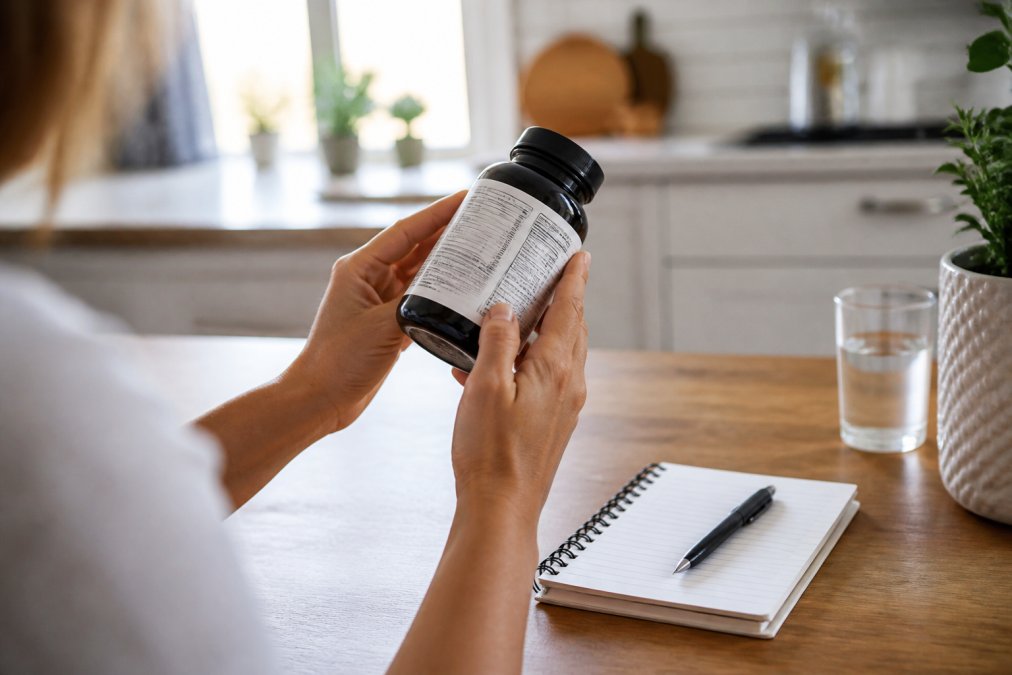
Reading a Label Like a Quality Auditor
Work through these checks in order. Any failure is worth pausing over.
| What to Check | What Good Looks Like | Why It Matters |
|---|---|---|
| Food business operator | Full name and UK address | Proves someone is legally accountable |
| Ingredient list | Complete, in descending order | Reveals formulation honesty |
| Nutrient amounts | Stated per serving with NRV % | Confirms dosage transparency |
| Health claims | Match the GB register wording | Shows regulatory awareness |
| Batch number | Printed on pack | Enables traceability |
| Warnings | Present and specific | Indicates proper compliance |
| Certification | ISO 9001 and ISO 22000 named | Evidence of audited systems |
Common Labelling Mistakes That Weaken Manufacturing Validation
Even well-run manufacturers slip on labelling, and each mistake undermines the credibility of everything behind it. The most frequent failures include:
- Vague ingredient descriptions such as "herbal blend" without quantities, which tells the buyer nothing about dosage.
- Unauthorised health claims that overstate what an ingredient does, inviting regulatory action.
- Missing NRV percentages on vitamins and minerals, which makes dosage comparison impossible.
- No batch number or best-before date, which breaks traceability entirely.
- Inconsistent serving information between the label and the website, which suggests poor document control.
Frequently Asked Questions
What information must be included on a UK food supplement label?
UK food supplement labels must show the product name, the word 'food supplement', the list of ingredients in descending weight order, the quantity of each active nutrient per serving, the percentage of the Nutrient Reference Value where one exists, the recommended daily dose, a warning not to exceed it, the statement that supplements are not a substitute for a varied diet, the name and address of the food business operator, the batch number, and a best-before date. Allergen information must be emphasised in the ingredients list. These requirements come from UK food labelling regulations that mirror retained EU law.
How can I verify the manufacturing standards of my supplements?
Start with the label itself. Look for a named UK manufacturer or food business operator with a full postal address, a batch number, and an ISO 9001 or ISO 22000 certification statement. Then check the manufacturer's website for batch traceability documentation, certificates of analysis, or a quality policy. GMP certified supplement manufacturing means the facility follows documented procedures for hygiene, equipment calibration, staff training, and record-keeping. If a brand cannot tell you who made the product and where, that is a warning sign.
Why is clear product labelling essential for consumer safety?
Clear labelling lets you check the exact dose of each active ingredient against the NRV, spot allergens, and confirm the product is suitable for your age group or health situation. It also carries warnings about caffeine content, interactions with medication, and who should avoid the product. Without accurate product labelling, you cannot tell whether a capsule contains what it claims or whether it is safe for you. Labelling is the primary communication channel between the manufacturer and the person taking the supplement.
What is the difference between a label claim and a validated manufacturing standard?
A label claim is what the packaging says about the product, such as 'supports normal metabolism' or '100% NRV of chromium'. A validated manufacturing standard is the documented, auditable process behind that claim: batch records, raw material certificates, in-process checks, and finished product testing. The claim tells you what the brand promises. The standard proves the promise can be repeated batch after batch. Accurate product labelling is only trustworthy when a validated manufacturing system sits behind it.
How do UK regulations ensure the accuracy of supplement labels?
UK regulations require that all label information is truthful and not misleading. Nutrient quantities must be stated per recommended daily dose and must be accurate within defined tolerances at the end of shelf life, not just at manufacture. Health claims are restricted to those on the GB Nutrition and Health Claims Register, so a brand cannot invent a benefit. Enforcement is carried out by local authority trading standards and the Food Standards Agency. Non-compliant products can be withdrawn from sale.
What should I look for on a supplement label to ensure purity?
Check for a full ingredients list with no vague entries like 'proprietary blend' without quantities. Look for the specific chemical form of each nutrient, such as chromium picolinate or zinc citrate, because this affects absorption. Confirm the batch number and best-before date are printed, not stickered. Look for allergen declarations and any 'free from' claims. A traceability in supplement production system should let the brand link that batch number to raw material certificates. If the label is vague about what is inside, the manufacturing standards behind it are probably vague too.
Which Supplements Sanctuary products demonstrate strong labelling and traceability?
Supplements Sanctuary manufactures all its capsules in the UK in ISO 9001 and ISO 22000 certified facilities. Every product carries a batch number that links to internal traceability documentation. For example, GLUCAVIT Metabolic Balance Support lists each active ingredient with its exact amount and NRV percentage, including chromium at 20 micrograms per capsule. R+ Macronutrient Metabolism shows zinc at 14 milligrams (140% NRV) and chromium at 40 micrograms (100% NRV), with a clear allergen statement of 'None'. This level of detail is what accurate product labelling looks like in practice.
Does a batch number on a supplement label actually prove anything?
A batch number is only useful if the manufacturer keeps records that link it to specific raw material lots, production dates, and quality checks. Under GMP certified supplement manufacturing, each batch must have a manufacturing record showing what went in, who made it, what equipment was used, and what tests were performed. If you contact a brand with your batch number and they cannot tell you when it was made or which raw materials were used, the number is decorative rather than functional. Traceability in supplement production means the batch number opens a real paper trail.